Blog Search

Thursday, February 3, 2011

What is Overtraining?

Overtraining is typically the case when athletes train extensively without adequate rest time. In addition to this, all athletes are different and respond differently to certain training routines and stressors. Mental fatigue can also compound the stresses of training, as training and everyday activities involve a functional mind. If you do play many sports and train on top of that, you may encountour overtraining. Realize; however, that overtraining is difficult to diagnose.

If overtraining is a concern to you, you may want to familiarize yourself with some of the symptoms:

tired
drained
lack of energy
general aches and pains
sudden drop in performance
insomnia
headaches
increased susceptibility to colds
decrease in training capacity and intensity
moodiness and irritability
depression
loss of appetite
increase in injury susceptibility


If you are experiencing a wide range of these symptoms, you can further investigate this issue by doing am orthostatic heart rate test. Here is a link that will guide you through the test. http://www.brianmac.co.uk/hrtest.htm

You are the best person to gauge how your body feels. If you do feel these symptoms and are overtraining, you are best to either reduce the amount of exercise, or stop it completely for a few days to allow your body to rest.

Wednesday, December 22, 2010

Post-Exercise Soreness

It is not unusual to feel soreness after a workout; DOMS (Delayed Onset Muscle Soreness) is the term used.

DOMS is usually felt twelve to fourty-eight hours after the workout, and is usually at it's worse fourty-eight hours after the activity. The soreness can even last a few days longer, decreasing as the days pass.

The soreness is a normal response to unusual exertion and is your body's way of adapting to the stressor. I emphasize the word soreness. If you feel pain, that is likely due to a sustained injury.

Monday, August 9, 2010

Muscle Fibres of the Skeletal System

Did you know that the human body's skeletal system is composed of a combination of two different muscle fibres?

These two fibres are as follows:
1- Fast Twitch (FT) or Type II (also called white fibres because of their microscopic appearance)

2- Slow Twitch (ST) or Type I (also called red fibres, again because of their microscopic appearance)

FT fibres are more anaerobic (does not rely of oxygen), larger, fatigue quicker, and have a faster contraction speed compared to ST fibres. These qualities make FT fibres ideal for actions that involve quick bursts of power and energy, such as jumping and sprinting. Events such as swimming, long-distance running, or cycling that require endurance, depend on the aerobic (relies of oxygen), smaller, slow contracting ST fibres.


Muscles fibres do not always fall into these two categories. There are also fibres that contain characteristics from both. These fibres fall into the Type II category, further dividing them into Type IIa and Type IIb. The more aerobic Type IIa fibre that contains more surrounding capillaries, thus; expressing greater resistance to fatigue than the anaerobic Type IIb fibre.

Through heredity an individual is dealt a composition of muscle fibres. These fibres cannot be altered by training, i.e. an individual cannot use training stimuli to transform one fibre type to another. However, most skeletal muscle contain both FT and ST fibres. The amount varies from one individual to another, as well as one muscle to another.

A conclusion can be made that individual performances occur as a result of varying percentages of muscle fibre types, which make some individuals better suited to specific activities. That does not mean, however; that training will not improve what fibres you already have.


References
Klavora, P. (2004). Foundations Of Exercise Science: Studying Human Movement And Health. Toronto: Sports Books Publisher.

Sunday, May 30, 2010

The Push-Up

What is a push-up, why is it so difficult to perform, and what muscle groups does it exercise?

A push-up is a plyometric exercise that involves lifting your own body weight off of the ground. It can be difficult for some, and easy for others.

If you are one who finds performing a push-up difficult, not to worry, this is normal. Do not feel frustrated or get embarrassed, your muscles are just not conditioned enough to achieve this feat.

The main muscle group used to perform this exercise is your chest. In addition to your chest; however, your shoulders and triceps are also involved in the action.

How do you perform a proper push-up at your level?
If you find doing a typical push-up difficult, try this modified version.


Modified push-ups for the beginner

1 - Lie face down on the floor, legs together and straight with your knees touching the floor.

2 - With your elbows bent, place your palms on the floor beside your shoulders, fingers pointing forward.

3 - Slowly raise your body off of the floor until your arms are straight. Keep your back and legs in a straight line. Do NOT fully extend your arms, by locking out your elbows. This could lead to injury.

Also, make sure that you tighten your abdominal muscles while you perform this exercise to help protect your lower back.

4 - Slowly lower your body until your chest almost touches the floor.

5 - Repeat steps 3 and 4 until fatigued

Once you have mastered this beginner push-up (able to do 12 or more consecutively), it is time to move onto the next level.


Push-ups for the intermediate

1 - Lie face down on the floor, legs together and straight with the balls of your feet touching the floor.

2 - With your elbows bent, place your palms on the floor beside your shoulders, fingers pointing forward.

3 - Slowly raise your body off of the floor until your arms are straight. Keep your back and legs in a straight line. Do NOT fully extend your arms, by locking out your elbows. This could lead to injury.

Also, make sure that you tighten your abdominal muscles while you perform this exercise to help protect your lower back.

4 - Slowly lower your body until your chest almost touches the floor.

5 - Repeat steps 3 and 4 until fatigued.

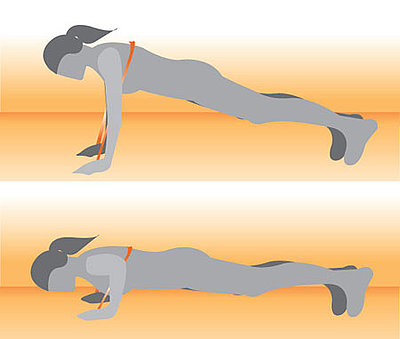
Once you have mastered the intermediate push-up and what a greater challenge, try this advanced version using an exercise band.


Push-ups for the advanced

1 - Place an exercise band around your upper back and below your underarms. Wrap the ends of the bands around your palms so that your hands are free to perform the push-up.

2 - Now, lie face down on the floor, legs together and straight with the balls of your feet touching the floor.

3 - With your elbows bent, place your palms on the floor beside your shoulders, fingers pointing forward.

4 - Slowly raise your body off of the floor until your arms are straight. Keep your back and legs in a straight line. Do NOT fully extend your arms, by locking out your elbows. This could lead to injury.

Also, make sure that you tighten your abdominal muscles while you perform this exercise to help protect your lower back.

5 - Slowly lower your body until your chest almost touches the floor.

6 - Repeat steps 4 and 5 until fatigued.

Other advanced push-ups can also me performed. Be creative and think of ways to make a push-up more difficult.