Blog Search

Sunday, May 30, 2010

The Push-Up

What is a push-up, why is it so difficult to perform, and what muscle groups does it exercise?

A push-up is a plyometric exercise that involves lifting your own body weight off of the ground. It can be difficult for some, and easy for others.

If you are one who finds performing a push-up difficult, not to worry, this is normal. Do not feel frustrated or get embarrassed, your muscles are just not conditioned enough to achieve this feat.

The main muscle group used to perform this exercise is your chest. In addition to your chest; however, your shoulders and triceps are also involved in the action.

How do you perform a proper push-up at your level?
If you find doing a typical push-up difficult, try this modified version.


Modified push-ups for the beginner

1 - Lie face down on the floor, legs together and straight with your knees touching the floor.

2 - With your elbows bent, place your palms on the floor beside your shoulders, fingers pointing forward.

3 - Slowly raise your body off of the floor until your arms are straight. Keep your back and legs in a straight line. Do NOT fully extend your arms, by locking out your elbows. This could lead to injury.

Also, make sure that you tighten your abdominal muscles while you perform this exercise to help protect your lower back.

4 - Slowly lower your body until your chest almost touches the floor.

5 - Repeat steps 3 and 4 until fatigued

Once you have mastered this beginner push-up (able to do 12 or more consecutively), it is time to move onto the next level.


Push-ups for the intermediate

1 - Lie face down on the floor, legs together and straight with the balls of your feet touching the floor.

2 - With your elbows bent, place your palms on the floor beside your shoulders, fingers pointing forward.

3 - Slowly raise your body off of the floor until your arms are straight. Keep your back and legs in a straight line. Do NOT fully extend your arms, by locking out your elbows. This could lead to injury.

Also, make sure that you tighten your abdominal muscles while you perform this exercise to help protect your lower back.

4 - Slowly lower your body until your chest almost touches the floor.

5 - Repeat steps 3 and 4 until fatigued.

Once you have mastered the intermediate push-up and what a greater challenge, try this advanced version using an exercise band.


Push-ups for the advanced

1 - Place an exercise band around your upper back and below your underarms. Wrap the ends of the bands around your palms so that your hands are free to perform the push-up.

2 - Now, lie face down on the floor, legs together and straight with the balls of your feet touching the floor.

3 - With your elbows bent, place your palms on the floor beside your shoulders, fingers pointing forward.
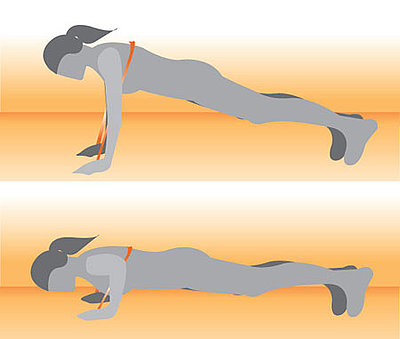
4 - Slowly raise your body off of the floor until your arms are straight. Keep your back and legs in a straight line. Do NOT fully extend your arms, by locking out your elbows. This could lead to injury.

Also, make sure that you tighten your abdominal muscles while you perform this exercise to help protect your lower back.

5 - Slowly lower your body until your chest almost touches the floor.

6 - Repeat steps 4 and 5 until fatigued.

Other advanced push-ups can also me performed. Be creative and think of ways to make a push-up more difficult.

Friday, March 19, 2010

Water and Weight Loss

Can water help me lose weight?

The answer is yes.

Water can help your body digest food, and also deceive it into thinking that its full.

Water and digestion
Before being distributed to the rest of your body for usage or storage, most of your food is temporarily stored in your stomach. Like food, most of the ingested water is also temporarily stored in your stomach. This food/water mixture together forms a great partnership. The water helps separate the food particles causing them to become more dispersed and spread out. This helps increase the efficiency of absorption.
.
Water and weight loss
As you know, your stomach is a temporary storage bin. Like a storage bin, your stomach reaches a fill point. At this point your stomach sends a signal to your brain letting it know that it has reached capacity. The sensation of being hungry then disappears.
.
Now that you are aware of this negative feedback mechanism, how can it help me lose weight. Again, this brings us back to the great partnership that food and water form with each other. As you may already know, water contains zero calories. This is important, because drinking water with your meal can result in you eating less food. Instead of solely eating, which plays a significant role is the amount of calories you consume, you are also ingesting water, which contains zero calories. What is happening is that you are replacing some of the food that you would normally intake, with calorie-free water. This will result in you consuming less food and less calories. In the long run, consuming less food and less calories will result in weight loss.

Wednesday, February 3, 2010

Fartlek your way through the winter blahs!

Living in Ottawa during the winter months can either be pleasant or weary, depending on what we make of it.

What can we do to make our Ottawa winters enjoyable, while exercising and taking part in some fun outdoor activities? How about incorporating Fartlek?

What is Fartlek, you may ask?
Fartlek, which means "speed play" in Swedish, is a cardiovascular training method that focuses on endurance.
.
Typically used by runners, the Fartlek method of training is implemented during the preparatory portion of their season. The reason they use this method is because it’s extremely flexible, and also develops basic cardiovascular endurance.

Fartlek can be done anywhere, at any time, and all year round. It is the combination of many cardiovascular training methods, like long slow distance training, interval training, pace and tempo training, hill training, fast burst training at various distances and lengths, training in parks, streets, beaches, etc. It can also be applied to any form of cardiovascular activity, such as swimming, cycling, skating, cross-country skiing, etc.

An example of a cycling training program using the Fartlek method is as follows:

10 min easy pace
4 min fast pace
2 min easy pace
2 min hill climb
2 min fast pace
30 sec all-out pace
4 min easy pace
10 min moderate pace
10 min easy pace
.
Remember, Fartlek training is just a change in time, tempo, distance and terrain. Mix these four elements up, and you'll have yourself a custom made Fartlek training program. Where better to practice Fartlek, than in Ottawa, were outdoor winter activities are virtually endless.

Take advantage of the Rideau Canal and skate on the world’s largest skating rink. Go snow shoeing, or cross-country skiing and explore the beauty of Ottawa’s endless snow trails. While you’re out there enjoying the winter, don't forget to incorporate some Fartlek. It’s easy, never boring, and you can create a great workout right on the spot.


References

Klavora, P. (2004). Foundations Of Exercise Science: Studying Human Movement And Health. Toronto: Sports Books Publisher.

Tuesday, January 12, 2010

Children and Physical Activity

Is it important to encourage children to participate in physical activity and sport?

Yes!

First off, there are immediate benefits to early exercise. These include:

  • an increase in self-confidence

  • reduction in stress and depression

  • weight control

  • continued development of healthy bones, muscles and joints
Secondly, evidence has shown that children who have received parental encouragement to participate in physical activity and sport will be more active as adults, compared to children who have been sedentary and lacked parental support.


.
Now start getting these children off the couch and moving!

Here are ways to get and keep your children active:

Be a role model
- be physically active yourself


Provide encouragement
- be positive
- build their self-confidence


Provide opportunities for your child to participate in sport and physical activity


- provide them with transportation and appropriate equipment

- participate in family or group activities
- register them in after school programs or sports teams

Remember, the most important factor to physical activity adherence is participant enjoyment. Give your child an opportunity to experience a variety of different activities, sports and programs, and give them the ability to choose ones they like.


References


Wold, B,. & Anderssen, N. (1992). Health promotion aspects of family and peer influences on sport participation. International Journal of Sport Psychology, 23, 343-359.